Measuring Volume & Capacity
How much space does something take up — and how much can a container actually hold? Learn the difference between volume and capacity, the customary units (cups, pints, quarts, gallons) and metric units (milliliters, liters) used to measure liquids, how to convert between them, and practice with the activities below — including a hands-on pouring game.
Volume vs. Capacity
These two words are close cousins, and people often use them to mean the same thing — but they're looking at a container from two different angles.
How much three-dimensional space something takes up — a solid block, a room, or a bottle including its plastic walls. Volume can be measured for anything, solid or liquid, in cubic units like cubic inches or cubic centimeters.
How much a container can hold on the inside — its maximum volume of empty space. Capacity is almost always used for liquids, and it's measured in units built just for that, like cups, liters, and gallons.
Customary Units
Customary units are the system most commonly used for everyday liquid measurement in the United States.
| Unit | Abbreviation | About the capacity of |
|---|---|---|
| Cup | c | A big glass of water, or a bowl of soup. |
| Pint | pt | A small carton of milk from the school cafeteria. |
| Quart | qt | A container of strawberries from the grocery store. |
| Gallon | gal | A jug of milk from the grocery store. |
Gallon, Quart, Pint, Cup
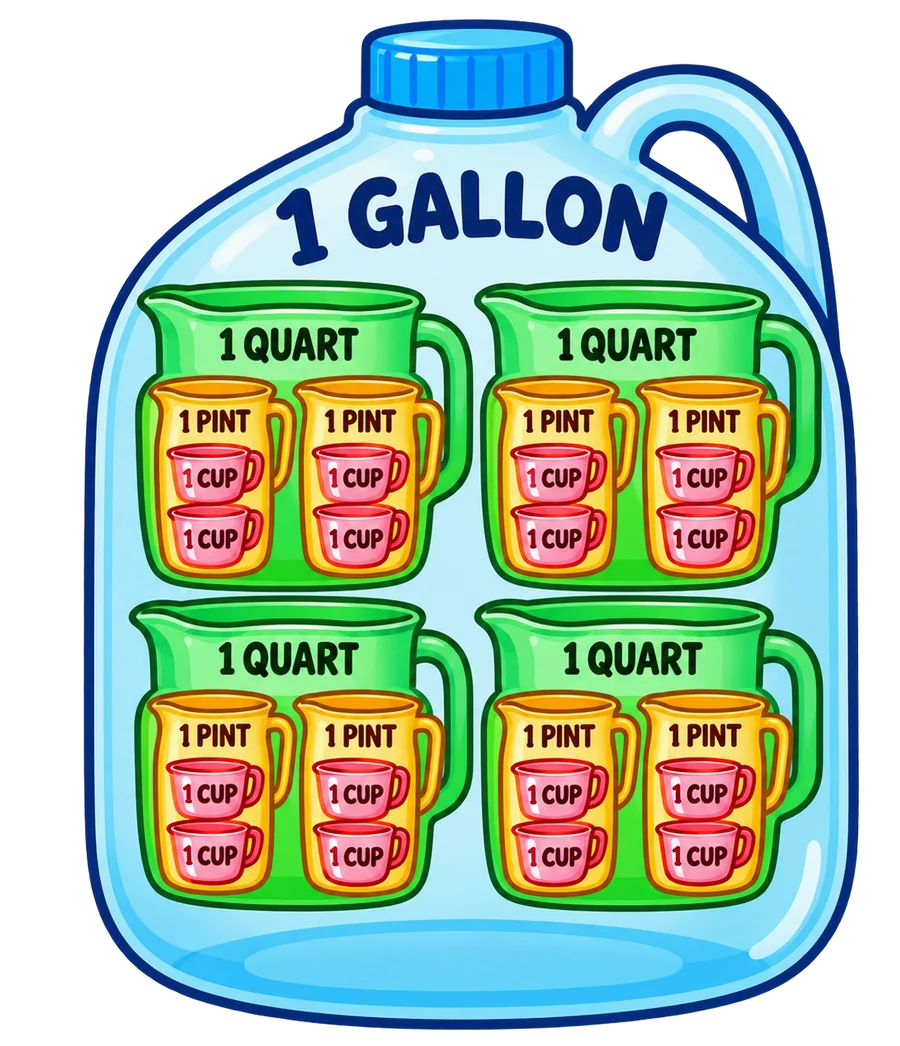
Here's the whole family in one picture: a 1-gallon jug is really just 4 quart pitchers put together, each quart is 2 pint cups, and each pint is 2 measuring cups. Follow the colors from the outside in to see how each unit is built from smaller ones — and from the inside out to see how the small ones combine into bigger ones.
Pint, Cup
Metric Units
The metric system is used by scientists everywhere and by most countries in the world. Its biggest advantage: every unit is related to every other unit by a power of 10, so converting is just a matter of shifting a decimal point.
| Unit | Abbreviation | About the capacity of |
|---|---|---|
| Milliliter | mL | A few drops from an eyedropper, or a spoonful of medicine. |
| Liter | L | A big bottle of soda, or a reusable water bottle. |
What the Prefix Means
Metric liquid units are built from the same base unit — the liter — with a prefix in front that tells you how it's scaled up or down.
| Prefix | Meaning | Relative to a liter |
|---|---|---|
| milli- | one thousandth | 1 mL = 0.001 L |
| (none) | the base unit itself | 1 L = 1 L |
You won't see a "kiloliter" in everyday life the way you'd see a kilogram or kilometer. A liter is already a useful everyday size for liquids, so the metric system almost never needs to scale it up any further.
Converting Between Units
Converting within a system just means multiplying or dividing by the relationship between the two units.
Practice
Four ways to practice what you've learned.
Pick the Best Unit
Choose the unit that makes the most sense for each measurement.
Conversion Practice
Type your answer as a whole number and check it.
Which Holds More?
Two measurements, two different units. Which one is actually more — or are they equal?
Pour It Right!
Tap the pitcher — or use the buttons below — to pour until it has exactly the right amount, then check your pour.